From Strength to Strength: Why Bunnings' Marketplace Keeps Growing
Of the Australian retailers that bolted a marketplace onto a store network, Bunnings is the only one reporting strong growth. A teardown of why it works.
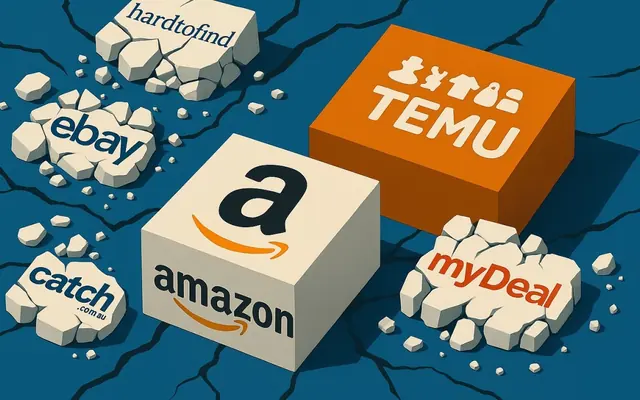
In June, I wrote that Australia's online marketplace boom had met a culling. Catch gone. MyDeal gone. BikeExchange taking a break. Endeavour Marketplace now shuttered.
One line from that piece deserves a full teardown. Of the Australian retailers that bolted a marketplace onto a store network, Bunnings is the only one reporting strong growth.
Amazon is bigger and still growing, and it runs 1P too. But third-party sellers are core to Amazon's business. At Bunnings, the marketplace is an extension of the shelf. If you're an Australian retailer with stores wondering whether a marketplace can work for you, Bunnings is the one to look at.
So this is the Bunnings breakdown. Same format as before: the facts first, then a separate section where I get into the why. The short version is that Bunnings runs the best marketplace of any Australian bricks-and-mortar retailer, and it's designed so the business would be fine without it. That's exactly why it works.
The numbers that matter
Wesfarmers released its 2026 results on 27 August 2026. The Bunnings lines:
- Revenue of $20.4 billion, up 4.1 per cent.
- Earnings of $2.46 billion, up 5.1 per cent.
- Return on capital of 69.2 per cent.
- Store-on-store sales up 3.7 per cent.
- Digital sales at 7.6 per cent of total sales.
- Marketplace "continuing to deliver strong growth following ongoing range expansion", plus new commercial and services marketplaces.
- 288 warehouses, 65 smaller format stores and 26 trade centres.
- Bunnings Marketplace launched in New Zealand on 16 September 2026, opening with selected sellers and adding more from October.
Bunnings also launched Buddy, which Wesfarmers itself describes as an "agentic commerce shopping assistant."
Put that next to the ledger from June. Catch reportedly cost Wesfarmers north of $400 million to wind down. In the same annual report that closed the book on Catch, the Bunnings marketplace was one of the growth lines. Same parent company, same economy, same Temu. Opposite result.
How it actually works
The Bunnings marketplace isn't new. It launched as MarketLink in December 2019, built on Mirakl, with about 8,000 offers on day one. The brief from Managing Director Michael Schneider was specific: "a highly curated range of products that extends and complements our in-store range... everything from the front gate to the back fence."
Read that again. Curated. Extends. Complements. Not "the everything store." Not "lowest price on the internet." Bunnings told the market in 2019 what the marketplace was for, and it hasn't drifted. It's about bringing more value to the customer.
The mechanics are standard 3P. Sellers hold their own stock, set their own price, ship direct to the customer and handle their own enquiries. Bunnings takes a commission. What isn't standard is the bar to get in and stay in:
- Respond to customer queries within one business day.
- Notify customers of any issues within one business day.
- Dispatch within two business days of order confirmation.
- Keep cancellations under 2 per cent.
- Keep disputes under 3 per cent.
You apply. You're assessed. Not everyone gets a merchant account.
And one detail most people miss: the famous Bunnings price guarantee does not apply to marketplace products. It never has. Bunnings said so at launch: because marketplace products aren't sold by Bunnings directly, the lowest prices policy doesn't extend to them.
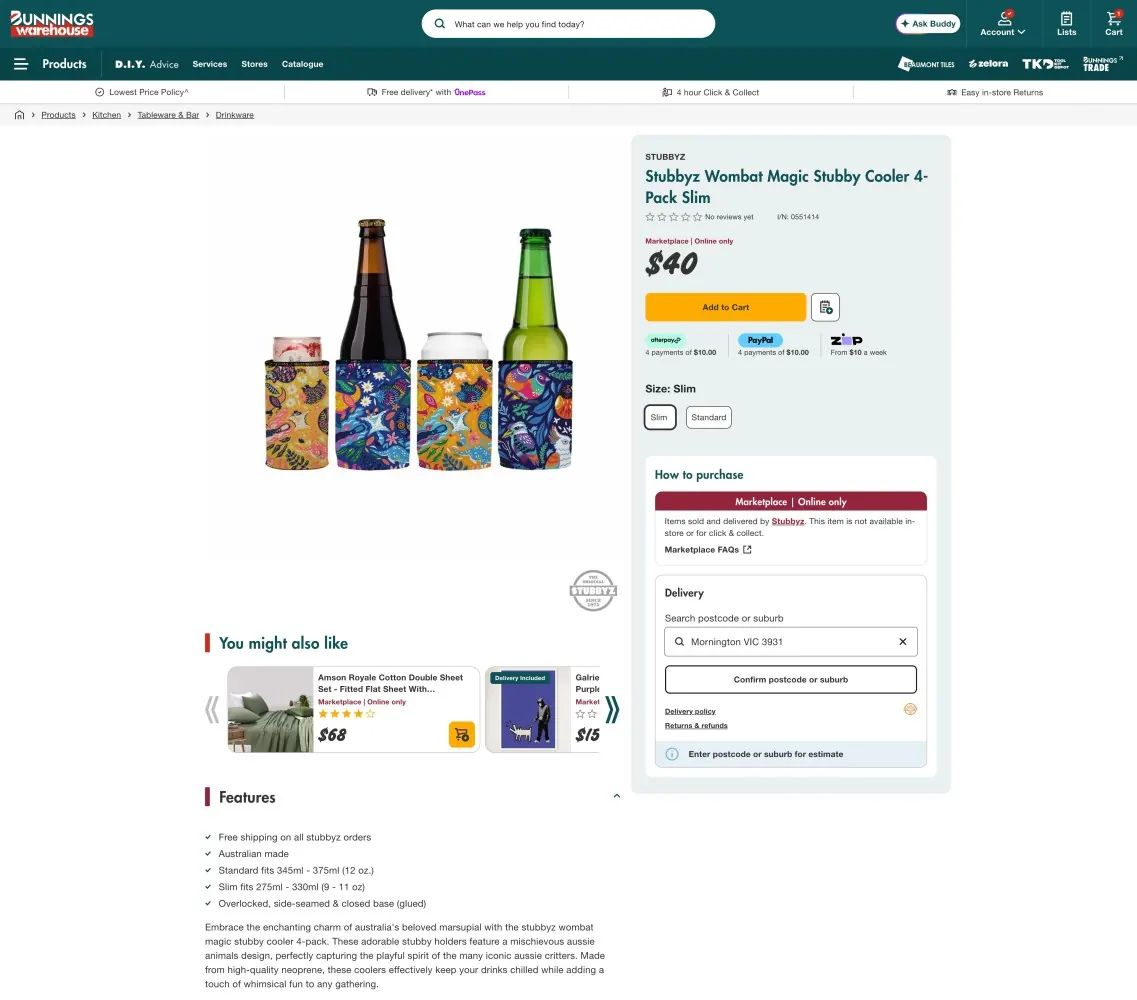
Stubbyz: The Original Australian Made Stubby Holder | stubbyz.com.au
Crossing the Tasman
On 16 September 2026, Bunnings switched the marketplace on in New Zealand. It wasn't a big-bang launch. It opened with a small number of selected sellers and is adding more from October.
It's the same playbook, sent across the Tasman. Same Mirakl platform. Same range strategy: sellers can list in NZ only in the categories they've already been approved for in Australia. Every product still goes through Bunnings approval. The curation travels with the marketplace.
The payments detail is the part I find most interesting. When an Australian seller sells to a New Zealand customer, Bunnings NZ collects and remits the GST, issues the tax invoice, and pays the seller net of GST and commission. The seller ships the parcel. Bunnings owns the customer transaction. For a small Australian brand that has never sold into New Zealand, that turns cross-border GST and invoicing from a project into a setting.
That's what a marketplace inside a trusted retailer can do that a standalone one can't. Catch never got the chance to take its sellers offshore. Bunnings just did it with a staged rollout.
Why it works
The following is my opinion. The facts above stand on their own.
1. The customer is already in the car park.
Every marketplace that died in my June article had the same problem: it had to buy its customer. Catch built a daily deals habit and then had to keep paying to feed it. MyDeal bought traffic against Amazon's ad budget and Temu's prices.
Bunnings never had that problem. When MarketLink launched in 2019, Bunnings was already the third most visited shopping site in Australia, before a single third-party product was listed. Hundreds of warehouses, a weekend habit for half the country, and a sausage sizzle out the front. The customer acquisition cost for a marketplace sale is close to zero, because the customer was coming anyway.
That's the whole game in e-commerce right now. Distribution is the hard part, and CAC against LTV is the real barrier. Bunnings solved distribution decades before it built a marketplace.
2. The range fills gaps. It doesn't fight the shelf.
Bunnings only lists marketplace products that sit alongside what it already sells. It isn't asking a seller to undercut its own tools & hardware. It's asking sellers to supply the long tail it would never range in store: the indoor furniture, the kitchenware, the niche outdoor gear, some stubby holders or other gifts that go with the barbecue...
Think about what someone buys at Bunnings on a Saturday in December. A new barbecue, an esky, a gas bottle exchange. A selection of products fit that basket without Bunnings needing to range one in a warehouse. That's what a marketplace is for.
This is the 1P/2P/3P point from June, played out properly. The 3P range widens the offer around the core. The core pays the bills. Everyone wins.
3. Curation is the moat.
Every marketplace says it wants quality sellers. Bunnings actually enforces it. One business day to respond. Two business days to dispatch. Cancellations under 2 per cent. That's a stricter SLA than many brands hold themselves to on their own websites.
Strict rules mean fewer sellers. But every one of them is trading under a Bunnings badge, and the badge is worth more than the listing count. Customers don't experience "a third-party seller." They experience Bunnings. When the parcel turns up on time, Bunnings gets the credit. When it doesn't, Bunnings gets the review. The rules exist to protect the brand, not the seller. A fair trade-off.
4. The price promise is fenced off.
This is the clever one. Bunnings' entire brand is built on lowest prices. If that promise covered every marketplace product priced by hundreds of independent sellers, it would be unenforceable within a week.
So Bunnings drew a line in 2019 and kept it there. The price guarantee covers what Bunnings sells. The marketplace sits outside it. That protects the 1P brand promise while still letting the marketplace grow range.
5. More than one way to get paid.
Bunnings is not living on a clip. It buys and sells its own stock (1P). It sets terms with suppliers on its own shelves (2P). It takes commission on marketplace sales (3P). And it's building a retail media business on top: Hammer Media now has more than 580 screens in about 250 stores.
Sound familiar? It's the Amazon stack, adapted for hardware. The marketplace commission is the least important thing on the list, which is exactly why Bunnings can run the marketplace for the customer instead of for the commission.
What sellers get, and what they give up
For a seller, the trade is clear. You get national reach on day one, and now a second country. Orders come in from every state and territory, from people who may never have found your website. You get trust you couldn't buy. And you get seasonality that follows the Bunnings calendar: Father's Day, summer, Christmas.
For a brand like Stubbyz, it is a chance to showcase its superior craftsmanship and colourful options to a broader audience. For Bunnings, it was the first time in its storied history that a stubby holder, a true icon of Australian outdoor life, became available. The collaboration opened new doors for Stubbyz, allowing products to be featured in Australia's most prominent home and garden retailer, renowned for its vast range of DIY products. The inclusion of Stubbyz in Bunnings' range solidified the brand’s position as a leader in the Australian drink cooler market.
Bunnings also rewards a certain kind of product. Australian Made, practical, a bit of humour, something that suits the backyard. Brands that look and feel like Bunnings do well on Bunnings. Brands chasing the cheapest possible landed cost are better off on Temu, and the customer can tell the difference.
The lesson for everyone else
Woolworths and Wesfarmers both learned this the expensive way. A marketplace works as a feature of a retailer that already owns the customer. It fails as a standalone business trying to buy that customer from scratch.
Bunnings is the clearest proof in the country. Its marketplace isn't the business. It's range extension for a business that was already winning. Strip the marketplace out tomorrow and Bunnings still turns over $20 billion.
If you're a retailer thinking about standing up a marketplace in 2027, ask yourself three questions:
- Do I already own the customer, or will I have to buy them?
- Does the marketplace range complement my shelf, or compete with it?
- Can I enforce standards strict enough that the customer never notices it's a third party?
If the answer to the first one is "buy them," stop there.
What could go wrong
Strong growth doesn't last forever. Range sprawl is the obvious risk: every SKU added is another chance to dilute what "Bunnings" means. Expanding into New Zealand, commercial and services marketplaces in the same year adds complexity. And Buddy is an early signal of the bigger shift coming. When AI assistants start shopping on our behalf, the car park advantage matters less if the customer never walks through the door.
That's where it gets interesting. And there's one corner of the market where nobody in Australia has built a Bunnings yet: B2B. Something to explore next time...