Agentic commerce: the funnel didn't die, it got bypassed.
The agent is the new shop window and the protocol is the new shelf. What agentic commerce means for retailers and payments.
First of all, no AI was used here.
I want to caveat that as I’m on the side that says it will become a more prominent statement over time. It doesn’t make me a luddite. I’m an avid AI user having long graduated through the ranks of Open AI and Gemini, and mainly use various forms of Claude across much of my builds.
TL;DR
Agentic commerce is AI agents acting as the buyer. Discovery, comparison, payment, and order placement collapse into one API-mediated decision. The funnel doesn't get optimised, it gets bypassed. Awareness, consideration, retargeting, even the PDP itself become invisible.
SEO mutates into AEO/GEO. Retail media has a measurement problem that's about to become existential. Brand matters more, not less, because preference has to be formed before the prompt.
The part that should worry every operator: the rails e.g. ACP, UCP, AP2 are being built by four or five companies (OpenAI, Google, Microsoft, Amazon, Anthropic) plus the existing card networks. The internet's promise of disintermediation is being quietly reversed. That's not a level playing field. That's a new gatekeeper layer with higher walls.
Clean your product data. Treat brand as infrastructure. Build owned channels. Watch the protocols. The window to influence the standards is closing fast.
We've been here before.
When Amazon opened its Seller Central, it rewrote a decade of retail "best practice" in eighteen months. Brands that had spent years building wholesale relationships with department stores suddenly had to learn marketplace economics, or watch their distribution model erode underneath them. When Shopify went mainstream, the cost of launching a direct-to-consumer brand collapsed and with it, the protective moats that incumbent retailers had relied on for decades. When Afterpay and the BNPL wave scaled, checkout itself became a marketing channel: payment options moved from a back-office plumbing decision to a top-of-funnel conversion lever.
Three platform shifts. Same pattern every time. The operators who saw it early made money. The ones who waited for "clarity" got margin-squeezed out.
Agentic commerce is the fourth shift. And honestly, it's the one that should worry the industry most not because it isn't real, but because of who gets to own the rails.
What agentic commerce actually is
Strip away the vendor noise and it's this: an AI agent acts as the buyer. You tell ChatGPT or Gemini or Perplexity "find me waterproof running shoes under $150 that I can receive by Friday," and the agent does the discovery, comparison, payment authorisation, and order placement. Your involvement collapses into a goal statement and a confirmation tap.
I asked this in Gemini and gave it a few hints to match my feet:
“For a narrow fit under $150 delivered by Friday, your clear winner is the Nike Pegasus Trail 5 GTX. It is consistently reviewed as having a snug, "locked-in" feel that suits narrow feet perfectly, especially with the added structure of the GORE-TEX liner. You can currently find them on sale for $168 at Active Feet or Sole Motive, while slightly over your $150 target, they are the most reliable option for your foot shape. To guarantee you have them for the weekend, I recommend Click & Collect from The Athlete’s Foot in [Suburb] or [Suburb], or ordering with Express Shipping from Active Feet today, as they typically dispatch via StarTrack Express for 1-2 business day delivery to [Suburb].
That’s not a chatbot. That’s a buyer with near delegated authority about to ask me for my credit card.
Would you like me to check if any of the [Suburb] stores specifically have your size in stock right now?
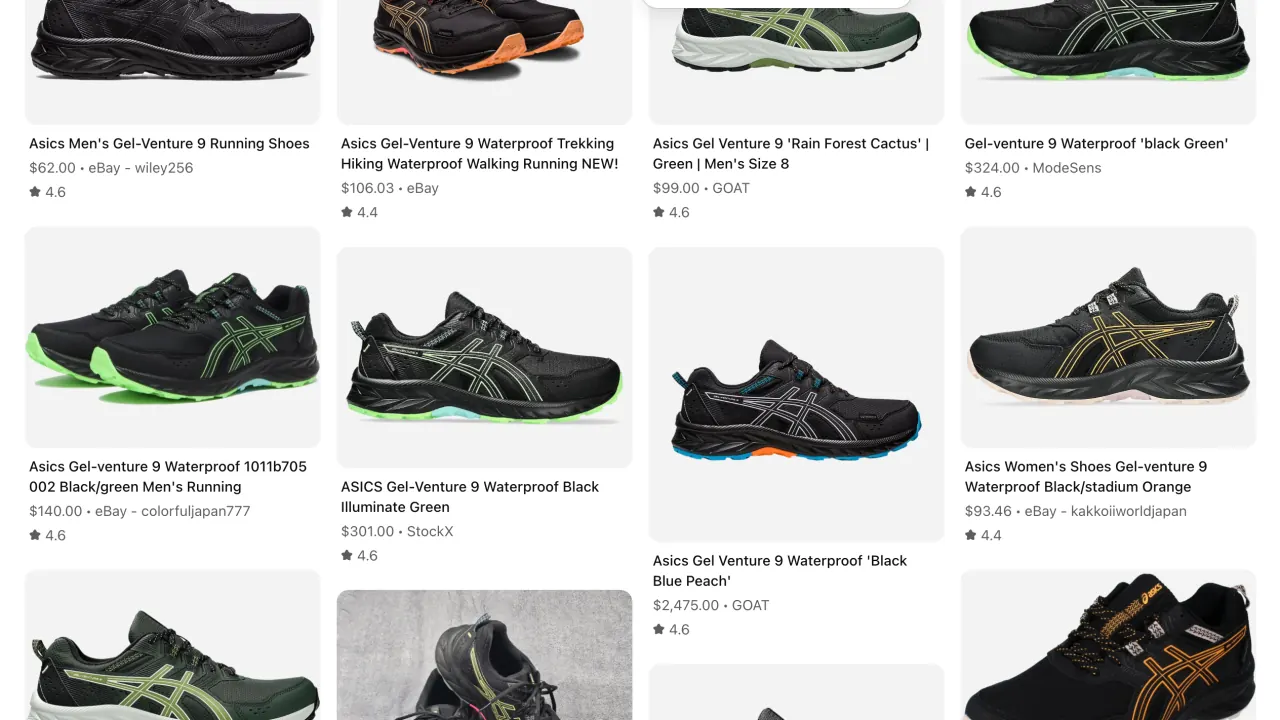
ChatGPT gave me something completely different and skipped independent retailers entirely. I’m concerned, actually as a lifelong e-Commerce guy, I’m very concerned. I asked if there were any independent retailers with the same shoes (ASICS) and price and it gave me two links which were both $20 & $25 cheaper than Amazon respectively. There was a “Browse All” which surfaced many more options and had a couple filters. When the filters start becoming useful, this will become the storefront.
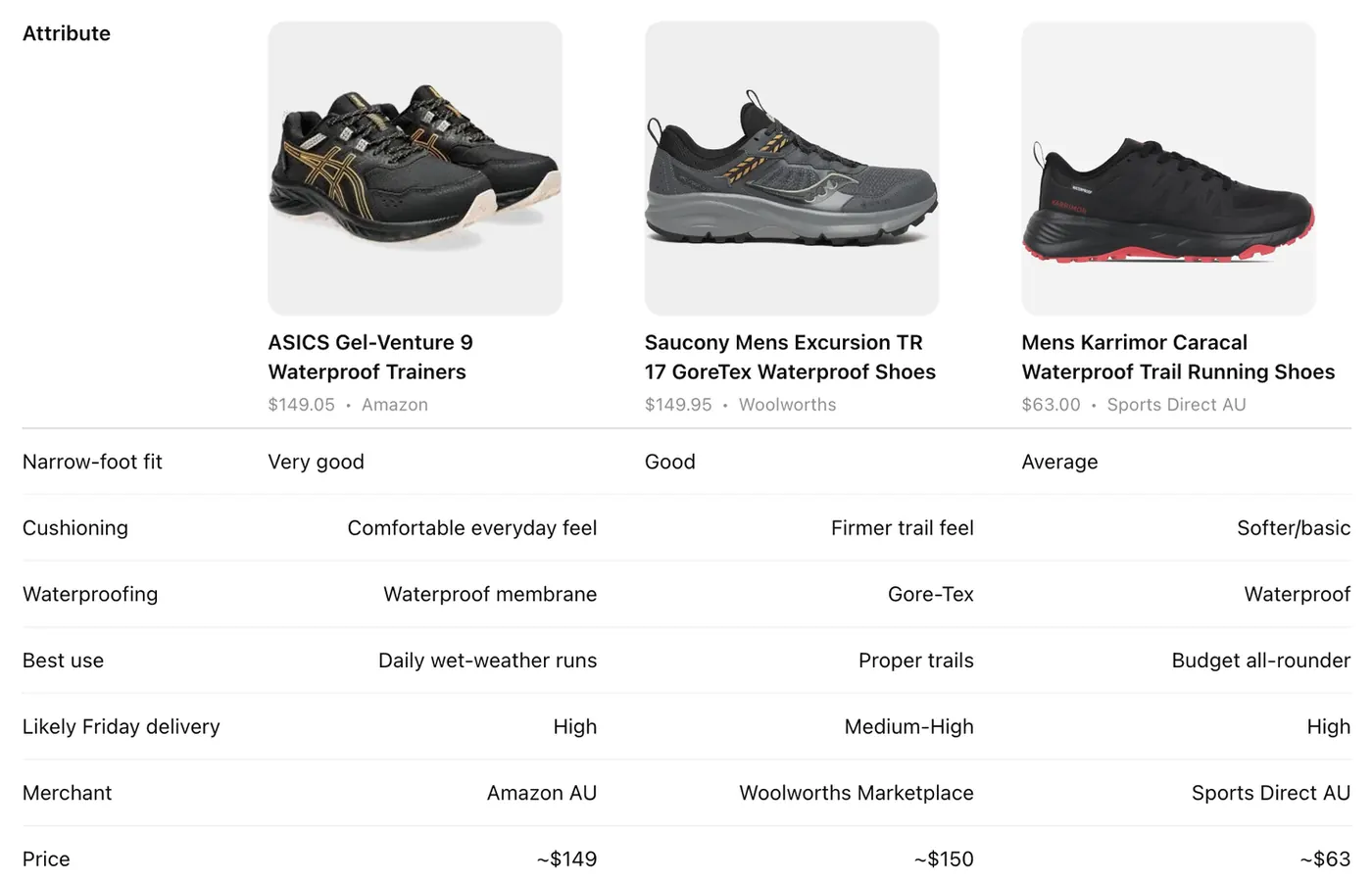
ChatGPT: Product search "...waterproof running shoes under $150"
The numbers
The numbers stopped being theoretical sometime in 2025. Shopify reports AI-driven traffic to its stores grew 8x year-over-year and orders from AI searches grew 15x. Adobe measured a 4,700% jump in generative-AI traffic to US retail sites between July 2024 and July 2025. Morgan Stanley reckons 23% of Americans bought something via AI in the past month. McKinsey is calling US$3-5 trillion in global retail spend orchestrated by agents by 2030. J.P. Morgan figures up to 25% of US online sales.
According to one of these sources, these new buyers from AI searches convert at almost twice the rate of traditional organic search.
Pick whichever forecast you find least insulting. They all point the same direction.
And the protocol layer is now real. Google launched the Universal Commerce Protocol (UCP) at NRF in January. OpenAI's Agentic Commerce Protocol (ACP), co-built with Stripe, is live with Instacart, DoorDash, Shopify, and Etsy. Microsoft Copilot Checkout went live in the US. Shopify, Stripe, Mastercard, Visa, Amex, Walmart, Target, Amazon, Meta, and Microsoft are all signed on to one or both. This isn't a pilot anymore. It's plumbing.
What it does to the funnel
If you've spent twenty years optimising the e-commerce funnel, awareness, consideration, decision, purchase, and retention, I have unpleasant news. The funnel doesn't get optimised in agentic commerce. It gets bypassed.
Walk through it stage by stage.
Awareness. Gone, or at least invisible to you. The customer didn't see your hero image, your banner, or your Meta ad. They told an agent what they wanted. Whether your brand was even eligible to be considered depends on whether your structured product data was clean enough for the agent to parse. As one analyst put it, "agentic AI does not disrupt the purchase funnel as a stage to optimise. It makes the funnel irrelevant as a planning framework."
Consideration. Happens inside the agent's reasoning window. The agent reads your schema e.g. product titles, descriptions, attributes, inventory, shipping ETAs, and reviews then compares them against everyone else's. Your beautifully art-directed PDP? The agent never sees it. There is no consideration phase you can touch.
Decision. A line of JSON. Either your SKU appears in the agent's response or it doesn't.
Purchase. A protocol handshake. ACP, UCP, AP2. The agent moves money through a card rail or a stablecoin protocol, and your fulfilment system gets the order. The first signal you receive that this customer exists is the add-to-cart event.
Retention. This one is the most quietly devastating. You don't get the browse data. You don't get the consideration patterns. You don't get the cookie. You get the transaction stripped of every behavioural signal you've been using to power personalisation, retargeting, and lifetime value. Your personalisation engine degrades a little with every agentic purchase, because the agent kept all the context.
The asymmetry is the point. The transaction arrives complete but contextless.
What this does to marketing
Let me be blunt. Most of what we call "digital marketing" e.g. paid search, paid social, programmatic display, retargeting, and retail media is built on the assumption that there is a human consumer with eyeballs that can be reached at a moment of consideration. Agentic commerce removes the eyeballs.
Search and SEO doesn't die, but it transforms into something that doesn't even resemble itself. Keyword density, backlink authority, and content moats lose value the moment an AI Overview answers the question without sending a click. We were already watching that happen. I already wrote about Google scraping 18 pages to deliver one visit and OpenAI's scrape-to-visit ratio going from 250:1 to 1,500:1 in six months. Agentic commerce doesn't reverse that. It finishes it. The new discipline is AEO (Answer Engine Optimisation) or GEO (Generative Engine Optimisation): structuring your product data, schemas, and authoritative content so that an LLM can confidently retrieve and cite you. No click or even attribution.
Paid media has a measurement problem first and an existential problem second. eMarketer is still forecasting US$72 billion (c. 99b AUD) in retail media spend for 2026. But retail media measurement assumes you can track brand influence on a purchase decision. In an agent-mediated decision, you can't. When advertisers can't measure, budgets move. The flow won't stop overnight, but the rationale is leaking.
Brand becomes the one lever that arguably gets more important, not less. Why? Because consumers still need to form preferences before they instruct their agents. The trail-running shoe brand that earned mindshare through creators, sponsorship, and authentic content is the brand a consumer asks for by name when they prompt the agent. That's preference shaping pre-prompt and it's mostly contextual, mostly cookieless, and mostly outside the performance-marketing playbook that's dominated the last era.
The part that actually worries me
Here's where my pragmatism gets a little dark.
The internet's original promise was disintermediation. A bedroom retailer could reach a global audience, build a brand, own a direct relationship with a customer, and route around the gatekeepers. That promise frayed when Amazon owned distribution and Google owned discovery, but it never fully died. There was always a Shopify store, a DTC play, a niche marketplace that could break through.
Shopify's stock is down around 25% year-to-date in 2026, with a 38% drawdown in February alone. The bull case and the bear case are both arguments about agentic commerce. Bears see a company whose Merchant Solutions revenue is dominated by Shop Pay and payments processing which is structurally exposed if AI agents route the transaction through their own checkout protocols and their own payment rails. Bulls see Shopify positioning itself as the infrastructure underneath the agents, co-authoring UCP with Google, syndicating product catalogues into ChatGPT, Copilot, and Gemini, and turning every merchant into an Agentic Storefront. The market hasn't decided which thesis wins. That uncertainty alone is the story.
Agentic commerce, as it's being architected right now, is a re-intermediation event of a scale we haven't seen. The agent is the new shop window. The protocol is the new shelf. And there are essentially four or five companies: OpenAI, Google, Microsoft, Amazon, and Anthropic controlling which agents most consumers will use to make most decisions.
Add in payments and it gets sharper still. ACP is co-built with Stripe. UCP is backed by Visa, Mastercard, Amex. The protocols privilege the existing card rails and the largest processors. The merchants who'll be most discoverable are the ones already on Shopify, Amazon, Etsy, or Walmart. Long-tail merchants, regional retailers, independent brands and anyone outside the integrated stack will need to invest heavily in structured data, schema, machine-readable feeds, and protocol compliance just to be eligible for consideration.
That's not a level playing field. That's a new gatekeeper layer with higher walls.
Will it dominate? Probably not entirely. Just like Amazon didn't kill independent retail, agents won't kill the consumer who wants to browse a beautiful brand site on a Sunday afternoon. But for the categories that are already commoditised such as basics, groceries, electronics or anything routine, the agent layer is going to absorb the transaction and the customer relationship.
What to do about it
If you're operating an e-commerce business right now, the honest priorities are unglamorous:
- Get your product data clean. Schema markup, structured attributes, real-time inventory accuracy, machine-readable shipping ETAs. If an agent can't parse you, you don't exist.
- Treat brand as infrastructure, not a marketing line item. The preference formed before the prompt is the only thing that's truly yours. Brand is everything in the new world.
- Build owned channels with everything you've got. Email, SMS, loyalty, first-party data, community. Anything that doesn't rely on an algorithm or an agent surfacing you.
- Watch the protocols. ACP, UCP, AP2 are not abstract, they will determine where your products can be sold and on what terms. The merchants who understand the rails will negotiate better positions than the merchants who don't.
And remember: every platform shift in my career has rewarded the operators who moved before the standards set. The window to influence those standards through trade bodies, partner programs, and early integrations is right now. It will close.
Agentic commerce isn't the end of e-commerce. It's the next era of it.
It's just one where the funnel has been replaced by an API call, and the API is owned by someone else.